
QuantumGenie vs QIZ
QuantumGenie and QIZ both describe platforms for discovering and managing cryptographic risk while preparing organizations for post-quantum cryptography, but the cited documentation emphasizes different operating models. QuantumGenie presents a connected workflow spanning discovery, attribution, remediation, and monitoring, including code-focused remediation artifacts and telemetry from edge environments. QIZ presents end-to-end cryptography management centered on organizational context, continuous discovery, prioritization, remediation planning, governance, APIs, and collaboration across stakeholders. These are vendor statements, not independent performance findings. The evidence does not establish that either platform is superior, nor does it provide comparable pricing, deployment results, test methodology, customer validation, or feature-by-feature implementation proof.12
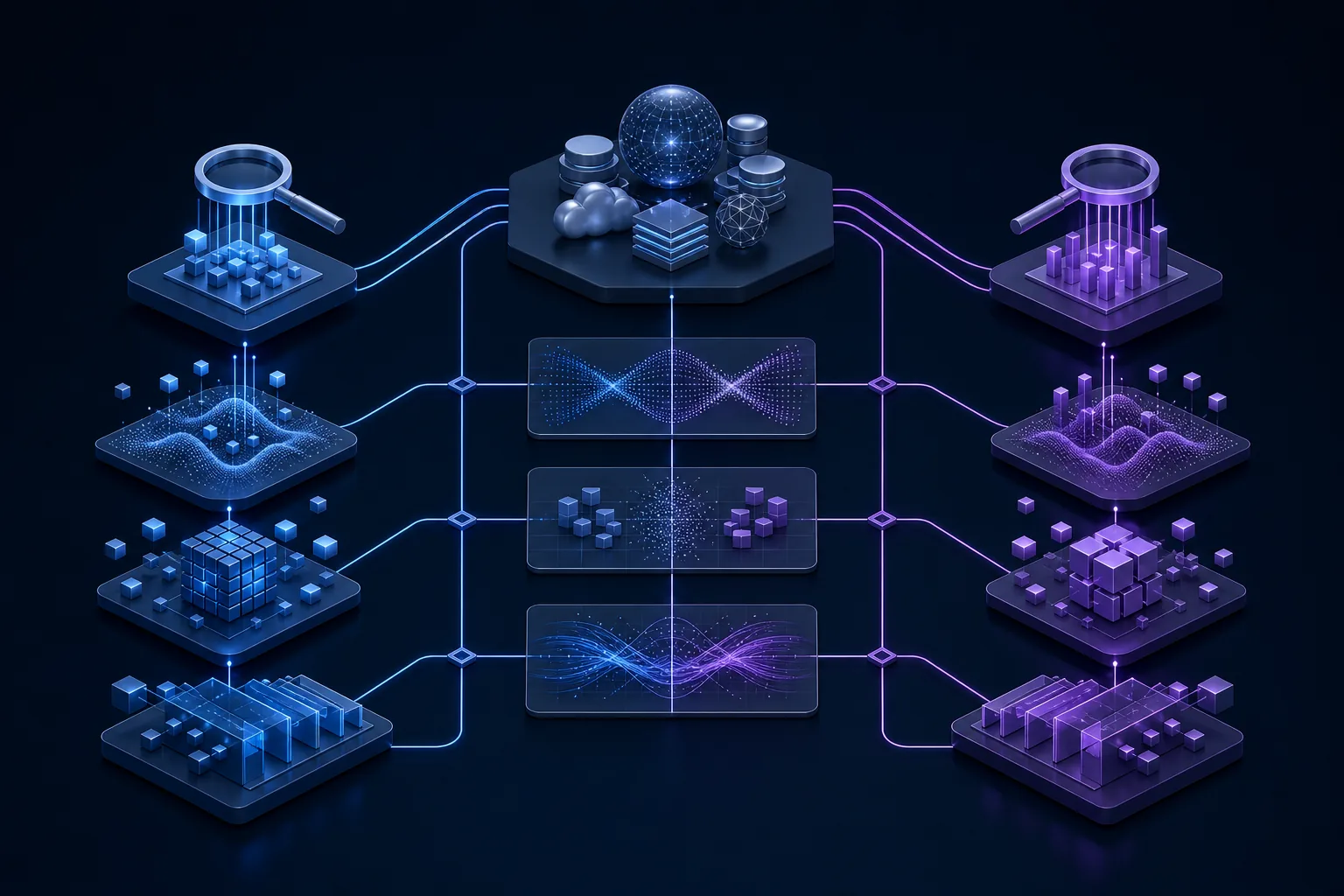
- Both vendors position their products around cryptographic visibility and post-quantum readiness, but the cited evidence is self-reported product documentation rather than independent validation.
- QuantumGenie’s documented workflow emphasizes discovery, causal attribution, AI-assisted remediation, and monitoring across enterprise and edge environments.
- QIZ’s documented workflow emphasizes contextual mapping, risk prioritization, end-to-end management, governance, APIs, and multi-stakeholder collaboration.
- Neither source set supports a ranking, a superiority claim, or a conclusion about actual implementation outcomes.
- A serious evaluation should validate coverage, data collection, remediation controls, integrations, governance outputs, operating cost, and evidence retention in the buyer’s own environment.
Scope and evidence basis
This comparison uses the cited passages from current documents identified in the source set. The QuantumGenie source is a current vendor platform page, and its documentation source is a current vendor documentation landing page; neither cited passage includes a publication date or document version. The QIZ source is a current vendor platform page and identifies a 2025 copyright notice in the cited passage. These dates and statuses matter: product pages can change, and a current status is not the same as independent proof of capability or outcome. All product descriptions below should therefore be read as vendor-reported scope.123
The broader technical context is also important. NIST’s cited overview, published on 2024-08-13, states that the first three finalized post-quantum cryptography standards were released in 2024. It explains that post-quantum algorithms are intended to protect against conventional and future quantum attacks, including for encryption and digital signatures. The NIST passage describes a developing technology area; it does not evaluate either QuantumGenie or QIZ. Likewise, the cited PQShield material explains that PQC runs on classical computers and that migration requires practical planning, visibility, crypto-agility, and sometimes hybrid approaches. Those sources provide context, not a product verdict.45
12Neutral comparison criteria
The most useful comparison is not a marketing-language contest. It is a set of explicit questions about operating scope and evidence. First, what assets and environments can the platform identify? Second, does it show relationships and dependencies, or only isolated findings? Third, how are findings prioritized? Fourth, does the documented workflow stop at advice, or does it produce controlled remediation artifacts? Fifth, how does the product support ongoing monitoring and governance? Finally, what evidence would a buyer need to verify each statement in a proof of concept?12
- Coverage: code, infrastructure, certificates, keys, applications, services, databases, identities, cloud, endpoints, IoT, or operational technology.
- Context: ownership, provenance, dependencies, application relationships, data flows, policy status, and business impact.
- Action: prioritization, migration planning, proposed changes, validation, pull-request artifacts, or other human-controlled remediation steps.
- Operations: continuous discovery, telemetry, monitoring, policy enforcement, APIs, reporting, and collaboration.
- Assurance: dated documentation, implementation evidence, test results, audit artifacts, and clearly stated limitations.
What QuantumGenie documents
QuantumGenie describes itself as a cryptographic security platform for the quantum era and presents a four-part sequence: discovery through CipherScan, attribution through a causal security engine, remediation through CipherNova, and monitoring through CipherEdge. The cited platform passage says that the platform maps applications, services, databases, identities, certificates, and keys across an enterprise and traces paths leading to weak or quantum-vulnerable cryptography. This indicates an intended model based on a connected cryptographic estate rather than a list of unrelated alerts.1
For discovery, the vendor says CipherScan automatically scans and inventories cryptographic assets across code, infrastructure, certificates, keys, cloud, and endpoints. A separate illustrative passage lists representative discovery surfaces including GitHub, GitLab, AWS, Azure, Google Cloud, Kubernetes, Docker, Terraform, databases, and endpoints. The same passage labels the scan illustrative and reports example counts such as 29,562 crypto assets, 18,441 certificates, and 94,328 keys. Those figures are presented as illustrative live-interface content, not as independently verified customer results or a benchmark.1
For attribution and remediation, QuantumGenie describes algorithm provenance, evidence, ownership, responsibility, and connections in its interface. It says CipherNova can propose secure fixes, validate them, and prepare review-ready code changes. The cited example describes an ML-KEM migration candidate, unit and integration tests, a security scan, performance checking, and a pull-request artifact for human review. This is a documented workflow claim. The evidence does not establish which repositories, languages, protocols, algorithms, or deployment conditions are supported, nor does it show that generated changes are safe without human review.1
For monitoring, QuantumGenie describes CipherEdge as using lightweight agents to collect cryptographic telemetry from endpoints, IoT, and OT environments and feed it securely into a cryptographic estate. The passage says the agents can work offline and synchronize when online, and it presents real-time risk detection. Another cited example shows a smart meter with a weak 3DES cipher and an expiring certificate. These passages indicate an intended edge-monitoring use case; they do not independently prove agent deployment coverage, telemetry integrity in production, detection accuracy, or operational safety.1
What QIZ documents
QIZ describes its platform as an end-to-end cryptography management system for discovery, prioritization, remediation, and governance. Its cited page says QIZ maps assets against policy, reveals vulnerabilities and dependencies, ranks risks by context, impact, and remediation effort, provides a step-by-step mitigation plan, and builds organizational cryptographic resilience and agility. The intended operating model is therefore centered on turning cryptographic findings into organizational decisions and managed work.2
QIZ emphasizes context across the organization. The cited documentation says it connects cryptographic assets with the services, protocols, and applications in which they are embedded, and exposes risks in motion and at rest. Examples include unencrypted databases, weak cipher suites, and outdated TLS. It says findings are ranked by impact and severity and that the result is a prioritized action plan. The evidence does not define the scoring formula, validation process, supported protocols, or accuracy of those rankings.2
QIZ also describes continuous discovery and policy enforcement, end-to-end management from on-premises to cloud, and collaboration among CISOs, compliance teams, and application owners. Its page calls the platform API-first and says it uses APIs without agents or probes, while allowing room for other methods where appropriate. These are material architectural and operating claims to test in a proof of concept. The cited evidence does not specify API coverage, authentication model, rate limits, supported integrations, deployment prerequisites, or whether every environment can be covered without additional collection methods.2
The QIZ passage says the platform is intended to answer three practical questions: what cryptography an organization uses, where it is applied, and what should be fixed first. It also positions QIZ for quantum readiness and crypto-agility. The cited evidence does not document a particular PQC implementation, algorithm library, migration code-generation capability, or cryptographic certification. Readiness management and cryptographic implementation are distinct evaluation areas and should not be conflated.25
Side-by-side interpretation
The comparison below summarizes the documented emphasis, not independently verified capability. Similar labels can conceal different implementation boundaries. For example, both vendors use language associated with discovery and remediation, but QuantumGenie’s cited passages give more detail about code changes and edge telemetry, while QIZ’s passages give more detail about policy context, organizational governance, APIs, and stakeholder collaboration. That difference should guide evaluation questions rather than serve as a ranking.12
A buyer should also distinguish an inventory from a risk decision. Inventory answers what has been found; context explains relationships and ownership; prioritization chooses what matters first; remediation changes a system; monitoring checks whether the situation persists. The evidence suggests that both vendors address several stages, but it does not establish equivalent depth at each stage or demonstrate that either product covers every asset type in a particular enterprise.12
| Criterion | QuantumGenie: cited emphasis | QIZ: cited emphasis | What remains to verify |
|---|---|---|---|
| Discovery and inventory | Code, infrastructure, certificates, keys, cloud, endpoints, and connected cryptographic estate | End-to-end cryptography discovery across organizational context, from on-premises to cloud | Actual asset coverage, collection accuracy, unsupported environments, and update latency |
| Context and prioritization | Attribution, provenance, evidence, ownership, responsibility, and connections | Contextual mapping, policy exposure, impact and severity ranking, and prioritized action plans | Scoring methodology, business-impact inputs, false positives, and reproducibility |
| Remediation | AI-assisted proposed fixes, validation, and pull-request artifacts for human review | Step-by-step plans to mitigate cryptographic risk and support remediation management | Supported code and algorithms, validation depth, rollback, and human approval controls |
| Monitoring and governance | CipherEdge telemetry for endpoints, IoT, and OT, including offline synchronization as described | Continuous discovery, policy enforcement, governance, collaboration, and APIs | Production telemetry behavior, reporting, access control, API coverage, and operating effort |
| Post-quantum readiness | Identification of weak or quantum-vulnerable cryptography and an illustrative ML-KEM migration workflow | Positioning around PQC readiness, crypto-agility, and cryptographic management | Actual migration implementation, standards alignment, certification, and completed transition evidence |
A practical evaluation plan
Start with a representative, bounded estate rather than a demonstration dataset. Include source repositories, certificates and keys, cloud services, databases, TLS configurations, identity systems, and—where relevant—IoT or OT endpoints. Record the assets that are intentionally in scope and the collection methods used. This prevents a vendor’s reported coverage from being mistaken for coverage of the buyer’s own environment.12
- Define the inventory baseline. Compare discovered assets with an independently prepared sample, and record false positives, false negatives, ownership fields, algorithm details, certificate status, and dependency relationships.
- Test prioritization. Provide the same deliberately selected weaknesses to each platform and document the criteria, severity model, business context, policy inputs, and resulting order. Do not compare labels without comparing their definitions.
- Test remediation controls. For any proposed migration or code change, require reviewable artifacts, test evidence, rollback procedures, and an explicit human approval step. Verify whether the platform merely recommends a change or produces a validated artifact.
- Test continuous operation. Measure update latency, handling of disconnected or changing assets, duplicate findings, telemetry retention, alert routing, and the effect of policy changes.
- Test governance and integration. Examine reports for executives, compliance teams, application owners, and operators; inspect APIs and access controls; and document the effort required to connect existing systems.
- Document exclusions and uncertainty. Record unsupported environments, unobserved dependencies, assumptions, required agents or probes, and the date and version of every test.
Evidence gaps and change risk
The source set does not provide comparable pricing, licensing, deployment architecture, service-level terms, independent security testing, customer references, measured discovery accuracy, performance benchmarks, or verified compliance certifications for either QuantumGenie or QIZ. It also does not establish the relative maturity of their integrations, remediation success rates, support models, or total cost of ownership. These omissions are not evidence of weakness; they are limits on what can responsibly be concluded from the cited material.12
There is also change risk. QuantumGenie’s cited pages contain interface-style examples and named product components, while QIZ’s cited page contains current positioning and a 2025 copyright notice. Product pages and capabilities may evolve. A procurement record should preserve the retrieved evidence, document status, dates, product version or release where available, and the results of a time-bounded evaluation. The comparison should be revisited if scope, architecture, or claimed workflow changes.123
- 01Set criteria
- 02Collect evidence
- 03Compare scope
- 04Record gaps
- 05Recheck changes
Conclusion
The cited evidence supports a neutral distinction in emphasis, not a winner. QuantumGenie presents a connected workflow from cryptographic discovery and causal attribution through AI-assisted, human-reviewed remediation and edge monitoring. QIZ presents end-to-end cryptography management focused on contextual mapping, prioritization, governance, APIs, and collaboration. Both descriptions are vendor-reported and lack independent comparative validation. The appropriate choice depends on the buyer’s verified requirements: asset coverage, collection architecture, code and edge needs, governance model, integrations, remediation controls, and evidence obligations. A representative proof of concept is necessary before drawing a product or procurement conclusion.12
Frequently asked questions
Does the evidence show that QuantumGenie is better than QIZ?
No. The cited evidence does not include an independent comparison, benchmark, customer outcome study, or controlled test. It supports a difference in documented emphasis, but not a superiority or ranking claim.12
Are QuantumGenie and QIZ implementations of post-quantum cryptography?
The cited passages position both products around cryptographic risk management and post-quantum readiness. They do not establish that either product is itself a PQC library, a certified cryptographic module, or proof that an organization has completed migration. Those questions require separate technical and assurance validation.25
What should be tested first in a proof of concept?
Test discovery against a known asset sample, then test dependency context, prioritization, remediation review controls, continuous updates, integrations, and governance outputs. Include the environments that matter to the organization, including code, cloud, certificates, databases, and edge or OT systems where applicable.12
Does QIZ’s API-first claim mean agents are never required?
The cited QIZ passage says the platform uses APIs without agents or probes, while leaving room for other methods where appropriate. It does not define universal coverage or the conditions under which additional collection methods may be needed. That should be verified for each target environment.2
Sources
- 1QuantumGenie Platform
QuantumGenie · current
Accessed July 25, 2026 - 2QIZ Security Platform
QIZ Security · current
Accessed July 25, 2026 - 3QuantumGenie Documentation
QuantumGenie · current
Accessed July 25, 2026 - 4What Is Post-Quantum Cryptography?
National Institute of Standards and Technology · current · NIST PQC overview
Accessed July 25, 2026 - 5Post-Quantum Cryptography
PQShield · current
Accessed July 25, 2026