In this article
A policy shift that makes a technical problem feel real
Post-quantum cryptography can sound abstract to non-specialists. A useful analogy is this: imagine a company locks its archives inside a vault that is strong today, but everyone knows a more powerful cutting tool is on the way. The risk is not only that the vault may be opened in the future. The risk is that adversaries can copy the vault now, store it quietly, and come back later with better tools. That is the logic behind “harvest now, decrypt later.”
A new White House executive order, Executive Order 14412, turns that idea from a technical warning into an operational agenda. The order says the United States must accelerate the transition of federal information systems to NIST-approved post-quantum cryptography, prioritize high value and high impact systems, and help critical infrastructure owners and operators plan their own transitions.
For a lay reader, the simplest takeaway is this: the conversation is moving from “Should we pay attention to quantum risk?” to “How do we inventory what we have, prioritize what matters most, and migrate before deadlines arrive?”
What the executive order actually changes
The order does not magically replace old cryptography overnight. Instead, it creates structure, deadlines, and accountability. Federal agencies must designate a PQC migration lead, review their inventories of high value assets and high impact systems, and develop plans for moving those systems to post-quantum standards.
Just as importantly, the order reaches beyond internal federal systems. It points toward future procurement pressure on contractors and asks for public guidance on the minimum elements of a cryptographic bill of materials, or CBOM. Think of a CBOM as the ingredient label for digital trust: it tells you where your certificates, algorithms, key establishment methods, and signing paths are actually hiding inside software and hardware.
That is why this matters to ordinary companies too. Even organizations that are not federal agencies often sell into regulated supply chains, connect to critical infrastructure, or rely on vendors who will soon be asked harder questions about cryptographic posture.
Key dates at a glance
| Milestone | What the order says | Why it matters in practice |
|---|---|---|
| Within 30 days | Each agency identifies a PQC migration lead. | Ownership becomes explicit. Quantum migration stops being “everyone’s problem” and starts belonging to a named program lead. |
| Within 90 days | OMB guidance will require agencies to review HVAs and high impact systems and submit migration plans. | Inventory and planning become mandatory management tasks, not optional research projects. |
| By Dec. 31, 2030 | HVAs and high impact systems should transition to PQC for key establishment. | Organizations need to find where key exchange and key establishment live today, especially inside TLS, VPNs, service meshes, device identity, and embedded systems. |
| By Dec. 31, 2031 | HVAs and high impact systems should transition to PQC for digital signatures. | Code signing, document signing, firmware signing, certificate workflows, and trust chains move to the foreground. |
| Within 270 days | CISA and NIST are directed to release public guidance on minimum CBOM elements. | Cryptographic inventory may become much more standardized, comparable, and automatable. |
Why this is bigger than a federal IT story
Many readers will ask: “We are not a U.S. federal agency, so why should we care?” The answer is that policy often flows outward like a tide. Federal agencies push their expectations into procurement. Procurement pushes vendors. Vendors push suppliers and subcontractors. Eventually, a decision that started in Washington appears in RFPs, questionnaires, remediation programs, and board-level discussions across the private sector.
A second analogy helps here. If the federal government changes building codes in a major earthquake zone, not every private building is forced to rebuild that same day. But builders, insurers, lenders, and inspectors all start asking different questions. Cryptography is heading in a similar direction. The order is a sign that the “new building code” for digital trust is being written now.
What this means for different audiences
| Audience | What likely changes | Immediate question to ask |
|---|---|---|
| Federal agencies | Program ownership, formal inventory review, migration planning, and deadline tracking. | Which systems are high value or high impact, and where is classical cryptography still present? |
| Federal contractors | Growing pressure to prove alignment with NIST standards and future FAR requirements if proposed rules become final. | Can we show our cryptographic posture quickly and credibly to a customer? |
| Critical infrastructure operators | Sector-specific migration planning and greater scrutiny over long-lived data and operational technology. | Which systems cannot fail, cannot be patched easily, or hold data with long confidentiality lifetimes? |
| Commercial enterprises | Rising board, customer, and regulator expectations around cryptographic visibility and transition readiness. | Do we know where our algorithms, certificates, key exchanges, and signatures actually live? |
Where QuantumGenie fits
The hardest part of post-quantum migration is usually not choosing a new acronym. It is finding the real trust paths inside a messy estate. Most organizations do not fail because they never heard of ML-KEM or ML-DSA. They fail because they cannot answer basic operational questions quickly enough: Which systems still use RSA or classical TLS? Which certificates sit in field devices? Which repositories contain vulnerable crypto patterns? Which assets touch long-lived sensitive data? Which vendor dependencies are blockers?
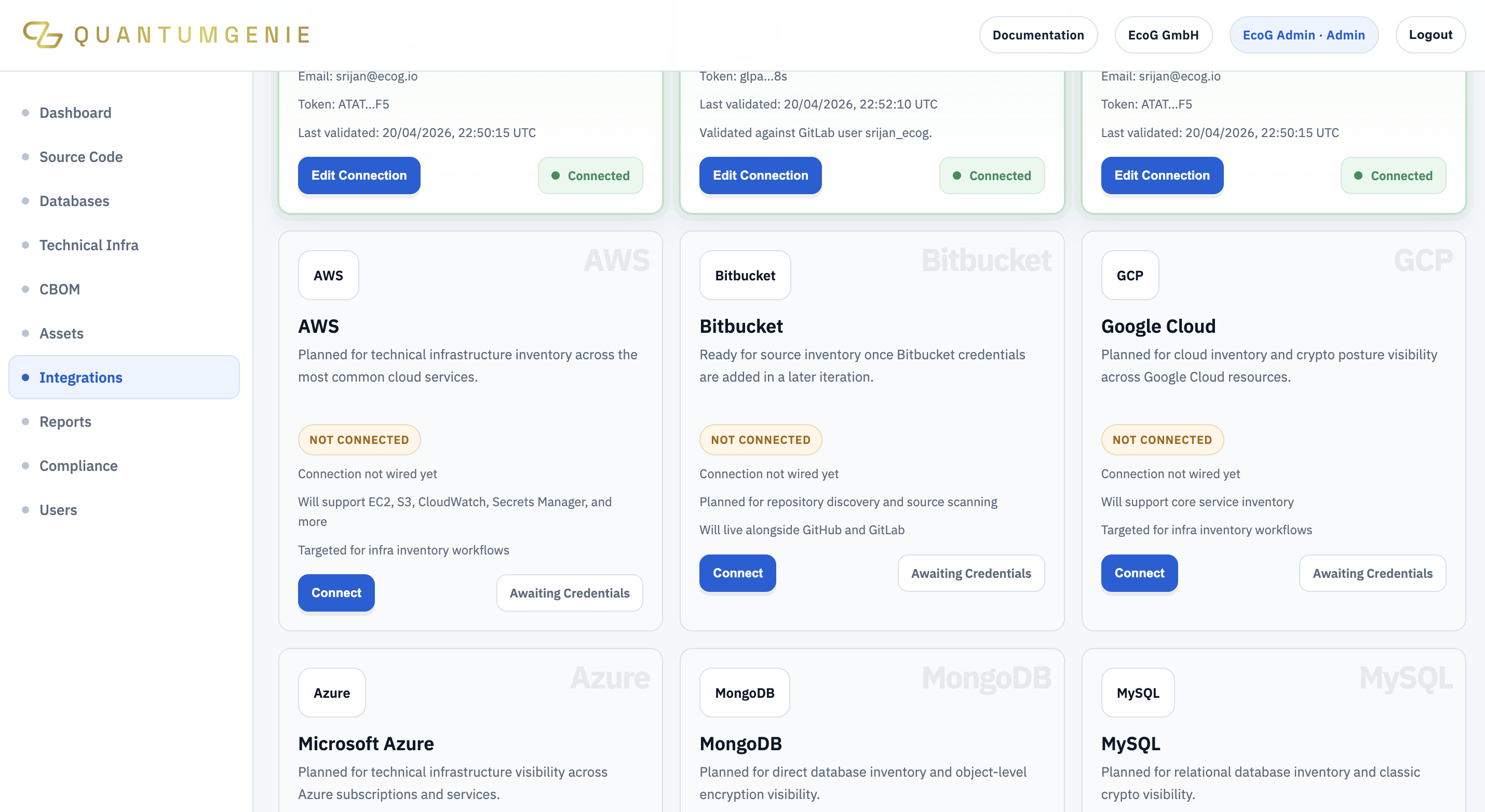
That is where QuantumGenie fits. We help teams move from uncertainty to a workable map. In practical terms, QuantumGenie is designed to discover cryptographic assets, surface migration blockers, connect findings to source code and runtime behavior, and turn visibility into remediation workflows.
QuantumGenie in four brief points
- CipherScan finds cryptographic exposure across source code, certificates, network paths, databases, assets, and infrastructure so teams can build a real inventory instead of guessing.
- CipherNova turns findings into remediation work by organizing rotation plans, upgrade waves, policy exceptions, verification steps, and engineering follow-through.
- Causal Security Engine traces a detected signal back toward the originating service, repository, file, and line so teams can understand causality rather than staring at isolated alerts.
- CipherEdge gives visibility into device and edge environments where certificate drift, signer health, field deployments, and hardware-linked blockers make PQC migration especially difficult.
How QuantumGenie maps to the order
| Need created or reinforced by the order | Why teams struggle | How QuantumGenie helps |
|---|---|---|
| Cryptographic inventory | Crypto is spread across code, certificates, libraries, service meshes, appliances, and devices. | CipherScan builds cross-surface visibility so the first inventory does not begin and end with certificates alone. |
| CBOM readiness | Most organizations do not have a structured record of cryptographic components and dependencies. | QuantumGenie’s CBOM-oriented discovery helps expose the “ingredient list” for digital trust across software and hardware elements. |
| Migration prioritization | Not every system is equally important, patchable, or under direct control. | We help separate directly managed systems from vendor-gated or hardware-limited paths so the migration plan is realistic. |
| Remediation execution | Even when risks are known, teams struggle to sequence rollout waves, testing, and ownership. | CipherNova turns findings into concrete queues, plans, and verification steps. |
| Root-cause attribution | Runtime alerts often do not explain which code path or deployment caused the problem. | Causal Security Engine helps narrow a signal down to the service, repository, file, and line most likely responsible. |
Questions a lay reader might still have
Does this mean classical encryption is broken today?
No. The more immediate concern is that migration takes years, while sensitive data can be captured now and held for later decryption. The order reflects that timing problem.
Is this just about federal agencies?
No. The federal deadlines apply directly to agencies, but the commercial ripple effects can extend into procurement, contractor expectations, critical infrastructure planning, and customer due diligence.
Why is inventory such a big deal?
Because you cannot migrate what you cannot find. In cryptography, the hidden work is often the real work: dormant certificates, embedded TLS, old signing paths, vendor dependencies, and long-lived archives.
The deeper implication: quantum readiness becomes an evidence problem
The order signals something subtle but important. Post-quantum readiness is not only a cryptography problem. It is an evidence problem. Leaders will increasingly need to show what they have, what they have prioritized, what remains blocked, and what has already been migrated. That is true for agencies, and it is becoming true for everyone who sells into regulated ecosystems.
In other words, the winning organizations may not be the ones with the loudest “quantum-safe” marketing. They may be the ones that can produce the clearest map, the cleanest inventory, the best migration sequence, and the strongest audit trail.