In This Article
What This Means
- Why Hardware Acceleration is Critical for Post-Quantum Cryptography
- Navigating the PQC Implementation Landscape: Insights from Recent Research
- How QuantumGenie Fits into Hardware-Accelerated PQC Migration
Why Hardware Acceleration is Critical for Post-Quantum Cryptography
Post-quantum cryptography introduces new algorithms that are significantly more computationally intensive than classical cryptography, especially for key encapsulation and digital signatures. This complexity impacts latency, throughput, and energy consumption, potentially hindering adoption in enterprise environments where performance and scalability are paramount. The recent announcement of PQPerform-Flex, a dedicated hardware accelerator for lattice-based PQC algorithms, highlights a pivotal advancement in addressing these challenges.
Hardware accelerators like PQPerform-Flex integrate directly into system-on-chip (SoC) architectures, offloading heavy cryptographic workloads from CPUs. For enterprises, this means enabling robust quantum-resistant encryption without compromising application performance or user experience. Such capabilities are especially critical in high-throughput scenarios including secure cloud services, IoT device management, and real-time financial transactions.
Navigating the PQC Implementation Landscape: Insights from Recent Research
Comprehensive surveys of PQC technologies reinforce the importance of hardware acceleration for practical PQC deployment. They underline that while software implementations provide flexibility, they often fall short in meeting performance requirements for widespread adoption. Furthermore, studies assessing PQC support across cryptographic libraries reveal uneven readiness, with many libraries lacking optimized hardware support. Enterprises must therefore strategize for a hybrid approach, combining hardware acceleration with agile software management to ensure seamless cryptographic transitions.
This evolving landscape demands that enterprises not only upgrade algorithms but also ensure their infrastructure and development pipelines can support these new computational paradigms. The necessity to adopt crypto-agile architectures is reinforced, emphasizing modular cryptographic components that can leverage accelerators while maintaining centralized governance and policy enforcement.
Key Considerations for Enterprise Hardware-Accelerated PQC Deployment
| Consideration | Implication for Enterprises | Role of QuantumGenie |
|---|---|---|
| Performance Impact | Hardware accelerators reduce latency and CPU load, enabling seamless PQC adoption | Identify performance-critical cryptographic endpoints requiring acceleration |
| Integration Complexity | SoC integration requires coordination between hardware and software teams | Map cryptographic assets to infrastructure components and workflows |
| Crypto-Agility | Flexibility to switch algorithms without hardware overhaul | Support agile migration plans with inventories and policy controls |
| Compliance Readiness | Demonstrate adherence to emerging PQC standards and certifications | Provide evidence-backed cryptographic inventories and migration status |
How QuantumGenie Fits into Hardware-Accelerated PQC Migration
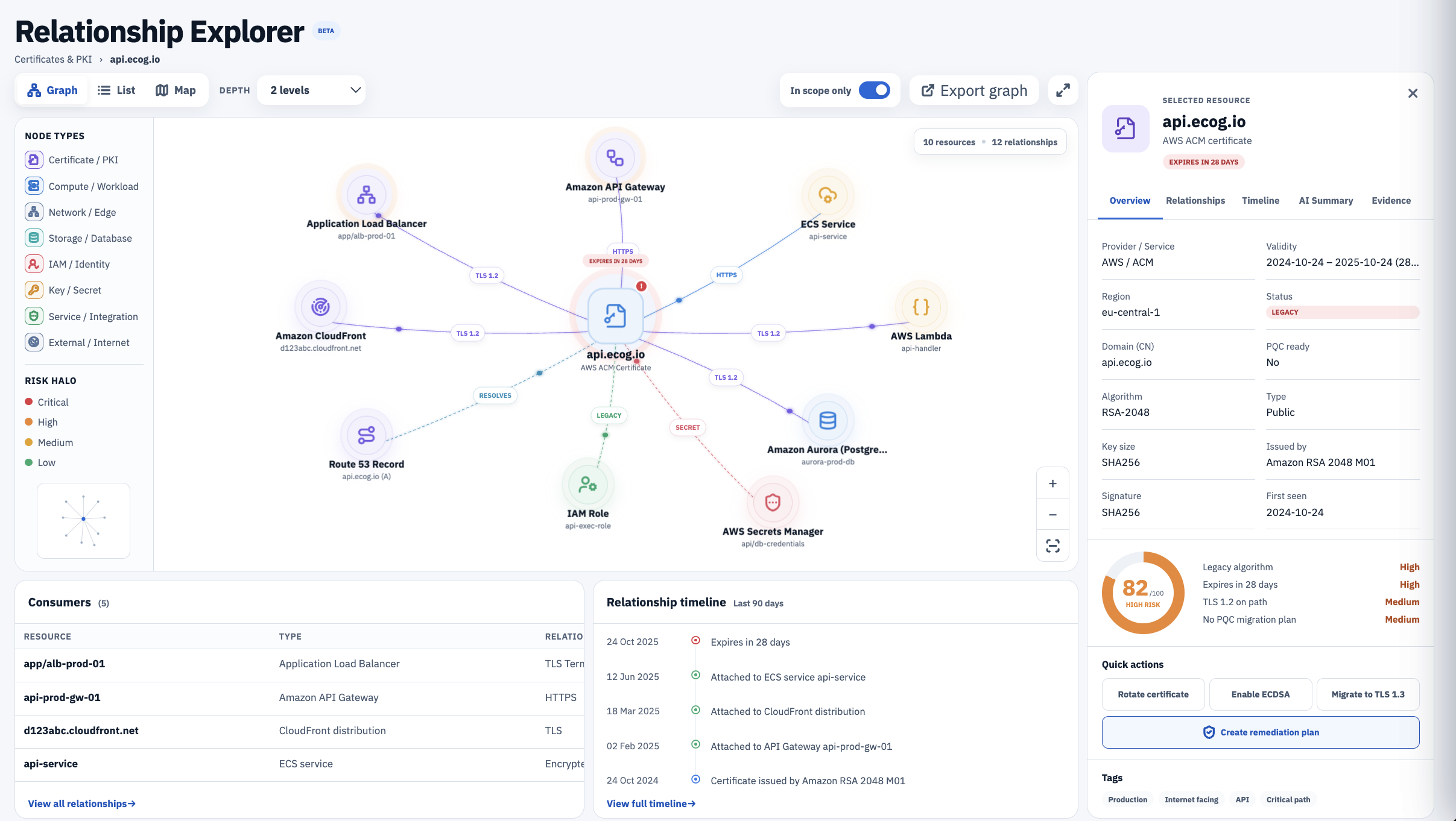
QuantumGenie plays a vital role in preparing enterprises for hardware-accelerated PQC adoption by delivering detailed cryptographic inventories and exposure assessments across diverse IT assets. This granular visibility enables security leaders to identify which cryptographic operations and protocols stand to benefit most from hardware acceleration, allowing for prioritized migration and integration planning.
Moreover, QuantumGenie's platform supports the development of cryptographic bills of materials (CBOMs), risk prioritization, and orchestrated remediation workflows aligned with hardware upgrade cycles. Such operational rigor ensures that organizations can align their crypto-agility goals with hardware investments, confidently transitioning to PQC-enabled infrastructures without disruption or compliance gaps. In essence, QuantumGenie bridges discovery and execution, making scalable PQC deployment practical and manageable.
Frequently Asked Questions
Why do enterprises need hardware acceleration for post-quantum cryptography?
Post-quantum cryptographic algorithms often demand more computation than classical ones, impacting system performance. Hardware acceleration offloads these intensive tasks, ensuring low latency and high throughput critical for enterprise-scale applications.
How does QuantumGenie facilitate the migration to hardware-accelerated PQC?
QuantumGenie provides comprehensive discovery and risk prioritization of cryptographic assets, enabling enterprises to align migration efforts with hardware upgrade plans, ensuring smooth transitions and compliance with emerging quantum-safe standards.
Watch The Quantum Threat
Sources And Further Reading
- PQPerform-Flex: PQShield's Post-Quantum Cryptographic Accelerator PQShield · Jul 24, 2026
- Post-Quantum Cryptography and Quantum-Safe Security: A Comprehensive Survey arXiv · Oct 12, 2025
- A Survey of Post-Quantum Cryptography Support in Cryptographic Libraries arXiv · Aug 22, 2024