In This Article
What This Means
- Ransomware's Quantum Leap: Psychological Warfare Becomes Technical Reality
- The Evolving Post-Quantum Ransomware Threat Landscape
- How QuantumGenie Fits: Bringing Visibility and Control to Post-Quantum Threats
Ransomware's Quantum Leap: Psychological Warfare Becomes Technical Reality
The cybersecurity landscape has taken a surprising turn with the Kyber ransomware group integrating post-quantum cryptography (PQC) into its malware arsenal. According to TechSpot, Kyber employs ML-KEM, a next-generation cryptographic standard designed to withstand attacks even from future quantum computers. Uniquely, Kyber’s adoption of PQC seems aimed less at technical invulnerability and more at intimidating victims by signaling sophistication and inevitability. This psychological tactic adds a new layer of complexity for enterprise defenders who must now contend with ransomware that pushes the boundaries of cryptographic resilience.
The Evolving Post-Quantum Ransomware Threat Landscape
Kyber is not an isolated case. A prior attack documented by Cloud360.net describes the BlackNova ransomware employing fully NIST-standardized post-quantum algorithms, rendering recovery of encryption keys nearly impossible, even with hypothetical quantum computing resources. These developments signify a shift in attacker capabilities and strategies — cybercriminals are starting to anticipate the post-quantum era and weaponizing PQC to solidify their control over victim systems. For enterprises, this escalation demands proactive cryptographic lifecycle management to identify vulnerable assets before attackers do.
Enterprise Actions Against Post-Quantum Ransomware Threats
| Challenge | Enterprise Response | QuantumGenie Role |
|---|---|---|
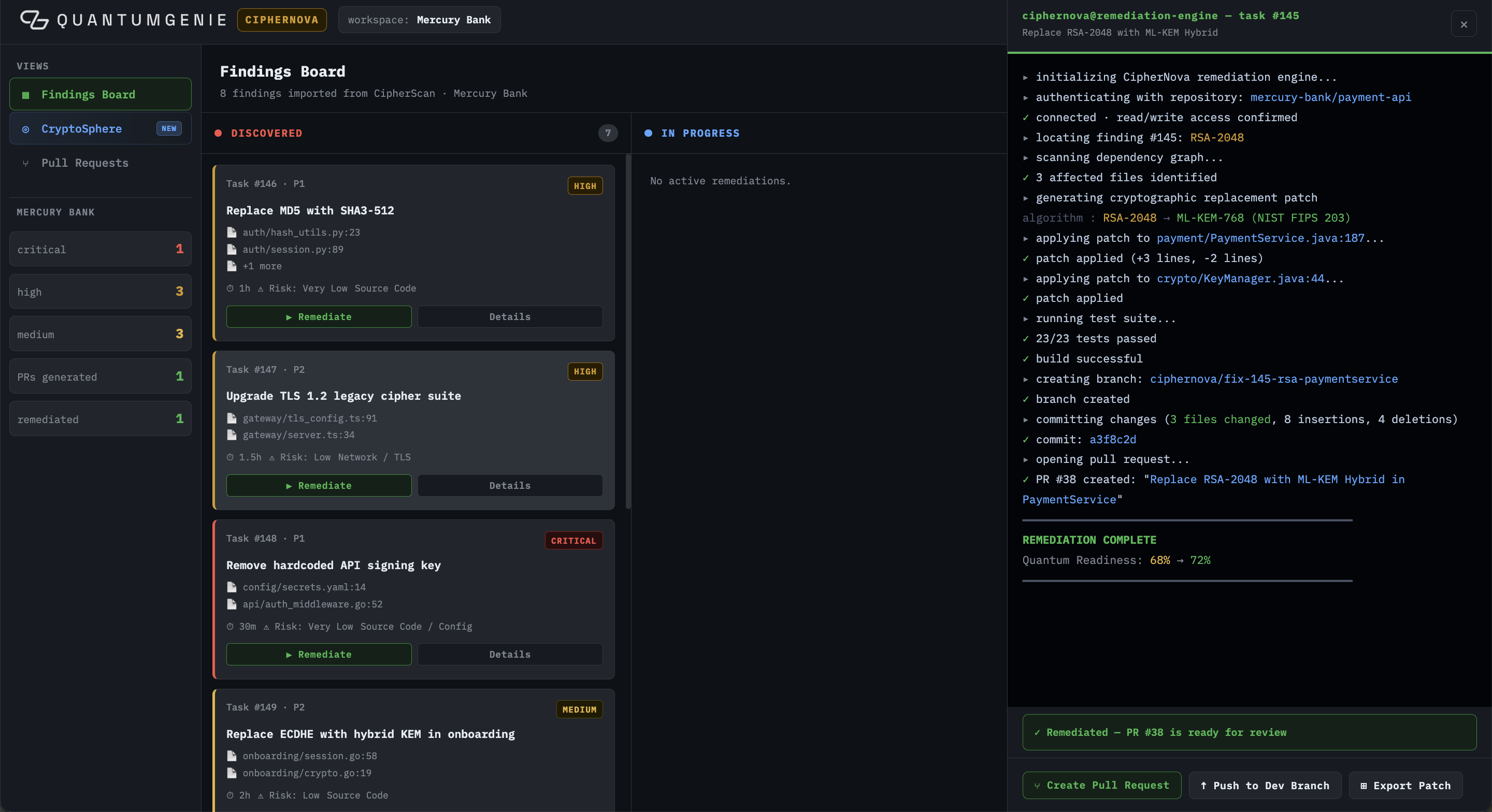
| Ransomware using PQC for psychological intimidation | Accelerate cryptographic inventory and risk prioritization | CipherScan discovers cryptography exposures comprehensively |
| Sophisticated PQC algorithms complicate key recovery | Develop action plans for migration to quantum-resistant algorithms | CipherNova orchestrates remediation workflows and change management |
| Compliance and audit requirements for cryptography | Ensure continuous compliance evidence and CBOM generation | Continuous monitoring and evidence generation supports compliance |
How QuantumGenie Fits: Bringing Visibility and Control to Post-Quantum Threats
QuantumGenie’s platform addresses this emergent threat by enabling continuous discovery of cryptographic implementations across the enterprise environment — including software, websites, certificates, applications, and infrastructure. By building a comprehensive cryptographic inventory and software bill of materials (CBOM), organizations can prioritize vulnerabilities related to legacy or quantum-insecure algorithms. QuantumGenie’s CipherScan layer provides the critical visibility needed to detect where these cryptographic risks lie, while CipherNova orchestrates remediation workflows aligned with compliance and migration plans. This operational capability is vital to mitigating ransomware risks that increasingly leverage post-quantum encryption as both a psychological and technical weapon.
Frequently Asked Questions
Why is the use of post-quantum cryptography by ransomware groups significant for enterprises?
It indicates that attackers are preparing for the quantum future, making attacks harder to mitigate and increasing the urgency for enterprises to migrate to quantum-resistant cryptography to protect critical assets.
How does QuantumGenie help enterprises respond to emerging ransomware threats with PQC components?
QuantumGenie provides continuous discovery and inventory of all cryptographic assets, enabling enterprises to detect vulnerabilities, prioritize remediation, plan migration strategies, and operationalize workflows to reduce risk from advanced post-quantum threats.
Watch The Quantum Threat
Sources And Further Reading
- Kyber Ransomware Implements Post-Quantum Encryption to Intimidate Victims TechSpot · Apr 24, 2026
- BlackNova Ransomware: First Documented Use of Post-Quantum Cryptography in Cyberattacks Cloud360.net · Mar 22, 2026