In This Article
What This Means
- From Theory to Practice: Hybrid PQC Implementations Enter Enterprise Reality
- Strategic Enterprise Implications: Inventory, Agility, and Governance
- How QuantumGenie Enables Practical Post-Quantum Migration Execution
From Theory to Practice: Hybrid PQC Implementations Enter Enterprise Reality
Recent announcements from FEDLIN highlight an important shift from abstract post-quantum cryptography (PQC) concepts to actionable enterprise readiness. Their approach centers on deploying ML-KEM and SLH-DSA hybrid algorithms that align with emerging FIPS 203/205 standards, a critical milestone indicating maturation beyond academic proposals.
This practical implementation underscores the multi-faceted nature of enterprise PQC migration: it’s not just about adopting new algorithms but integrating detailed cryptographic inventory, developing crypto-agile architectures, and cross-disciplinary coordination. Enterprises must identify all existing cryptographic touchpoints, from applications to infrastructure, to effectively embed hybrid PQC methods.
Strategic Enterprise Implications: Inventory, Agility, and Governance
The FEDLIN case study implicitly reveals core challenges CISO and enterprise architects face: the need for a holistic cryptographic inventory that generates a comprehensive cryptographic bill of materials (CBOM) and supports prioritization of migration risk. Such inventory is foundational for choosing where hybrid schemes like ML-KEM/SLH-DSA are applied iteratively.
Additionally, establishing a crypto-agility architecture enables transitioning from classical to hybrid post-quantum algorithms without disruptive outages or security gaps. Governance is also crucial — enterprises need audit trails and compliance evidence reflecting each migration step, especially with evolving standards like FIPS 203/205.
Key Enterprise Considerations for Post-Quantum Hybrid Cryptography Migration
| Consideration | Practical Insight | Role of QuantumGenie |
|---|---|---|
| Cryptographic Asset Discovery | Identify and inventory all cryptographic elements (certificates, keys, code, infrastructure) to build a CBOM | CipherScan provides automated, comprehensive cryptographic discovery across platforms |
| Crypto-Agility Architecture | Design systems to simultaneously support classical and post-quantum algorithms, allowing smooth migration | QuantumGenie supports visibility across legacy and PQC elements to track hybrid deployment progress |
| Migration Risk Prioritization | Focus on highest-risk cryptographic assets first for phased migration | QuantumGenie enables risk-based prioritization based on cryptographic exposure and compliance requirements |
| Compliance and Auditing | Maintain clear trails and documentation aligned with standards like FIPS 203/205 | QuantumGenie orchestrates remediation workflows and audit-ready evidence collection |
How QuantumGenie Enables Practical Post-Quantum Migration Execution
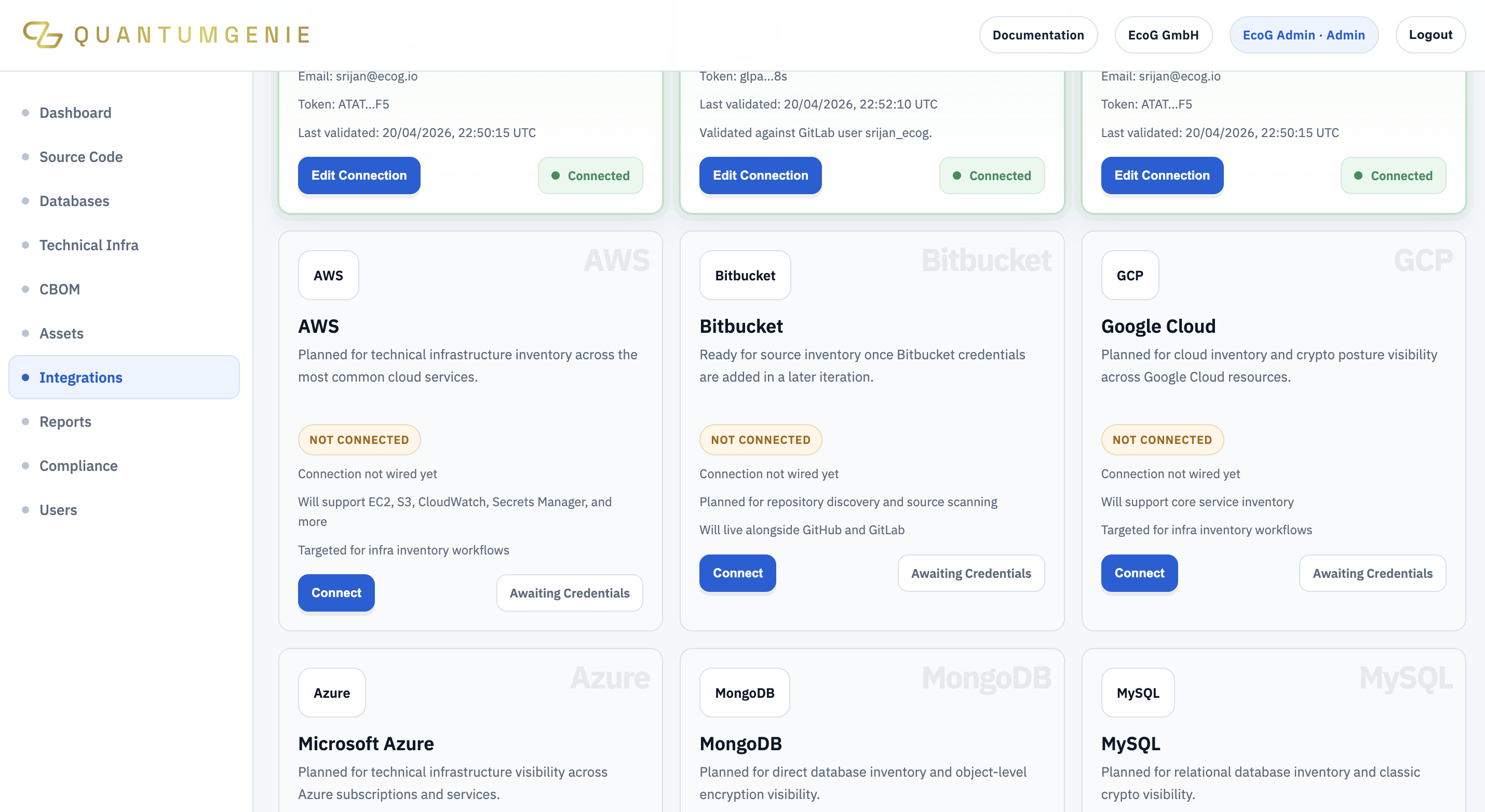
QuantumGenie addresses these enterprise needs by delivering detailed cryptographic discovery (CipherScan) across enterprise digital assets, producing a precise CBOM essential for migration planning. Its orchestration layer (CipherNova) supports workflow automation — managing prioritized remediation, hybrid implementation proofs, and policy exceptions effectively.
By bridging visibility with operational workflows, QuantumGenie empowers enterprises to execute complex hybrid migration scenarios as demonstrated by FEDLIN’s approach. It helps avoid common pitfalls by providing clarity on where cryptography resides, which elements require immediate attention, and how to document remediation for compliance — all critical for practical post-quantum readiness.
Frequently Asked Questions
What are ML-KEM and SLH-DSA and why are they important for enterprises?
ML-KEM (Machine Learning-based Key Encapsulation Mechanism) and SLH-DSA (Super Lightweight Hash-based Digital Signature Algorithm) are advanced post-quantum cryptographic algorithms designed to resist quantum attacks. For enterprises, integrating these hybrid algorithms alongside classical cryptography ensures security against future quantum threats while maintaining compatibility and operational continuity during migration.
How does a cryptographic bill of materials (CBOM) aid in post-quantum migration?
A CBOM is an exhaustive inventory of all cryptographic assets across an enterprise’s digital footprint. It helps organizations understand where cryptography exists, assess risk exposure, plan phased migration, and provide compliance evidence. Accurate CBOMs make complex migration manageable and reduce risks of overlooked vulnerabilities.
Watch The Quantum Threat
Sources And Further Reading
- FEDLIN's Post-Quantum Readiness: Implementing ML-KEM and SLH-DSA FEDLIN · Jul 8, 2026
- CyberSeQ's PostQ: Post-Quantum Cryptography Migration Platform CyberSeQ · Jul 8, 2026