In This Article
What This Means
- The EU’s Regulatory Push for Quantum-Resistant Encryption
- Practical Enterprise Implications: Inventory, Assessment, and Migration
- How QuantumGenie Fits Into the EU Quantum Encryption Compliance Journey
The EU’s Regulatory Push for Quantum-Resistant Encryption
The European Commission’s recent proposal to mandate quantum-resistant encryption across all member states by 2030 signals a profound shift in the cybersecurity landscape. This regulation recognizes the imminent threat posed by quantum computing to classical cryptographic schemes currently safeguarding sensitive data across enterprises.
For organizations conducting business or operating infrastructure within the EU, this wave of regulatory change underscores a non-negotiable imperative: comprehensively inventory cryptographic assets and systematically transition to quantum-resistant algorithms well ahead of the deadline. Failure to prepare risks both compliance violations and exposure to future cyberattacks exploiting quantum vulnerabilities.
Practical Enterprise Implications: Inventory, Assessment, and Migration
Enterprises face the complex challenge of mapping the sprawling cryptographic footprint embedded in websites, applications, certificates, databases, and connected infrastructure to understand where legacy algorithms persist. This inventory is foundational not only for compliance but also for risk prioritization and efficient migration scheduling.
Beyond discovery, organizations must factor in the transition path defined by international standards, such as those finalized recently by NIST, and adapt their strategies to align with both EU mandates and global best practices. A haphazard or incomplete approach can lead to cryptographic gaps, operational disruptions, and cascading regulatory penalties.

Key Steps for Enterprise Compliance with EU Quantum Encryption Regulations
| Step | Description | QuantumGenie Capability |
|---|---|---|
| Comprehensive Cryptographic Discovery | Inventory all cryptographic instances across platforms and codebases | CipherScan automated discovery and CBOM generation |
| Risk Prioritization | Identify highest risk cryptographic exposures vulnerable to quantum attacks | Risk scoring and prioritization modules |
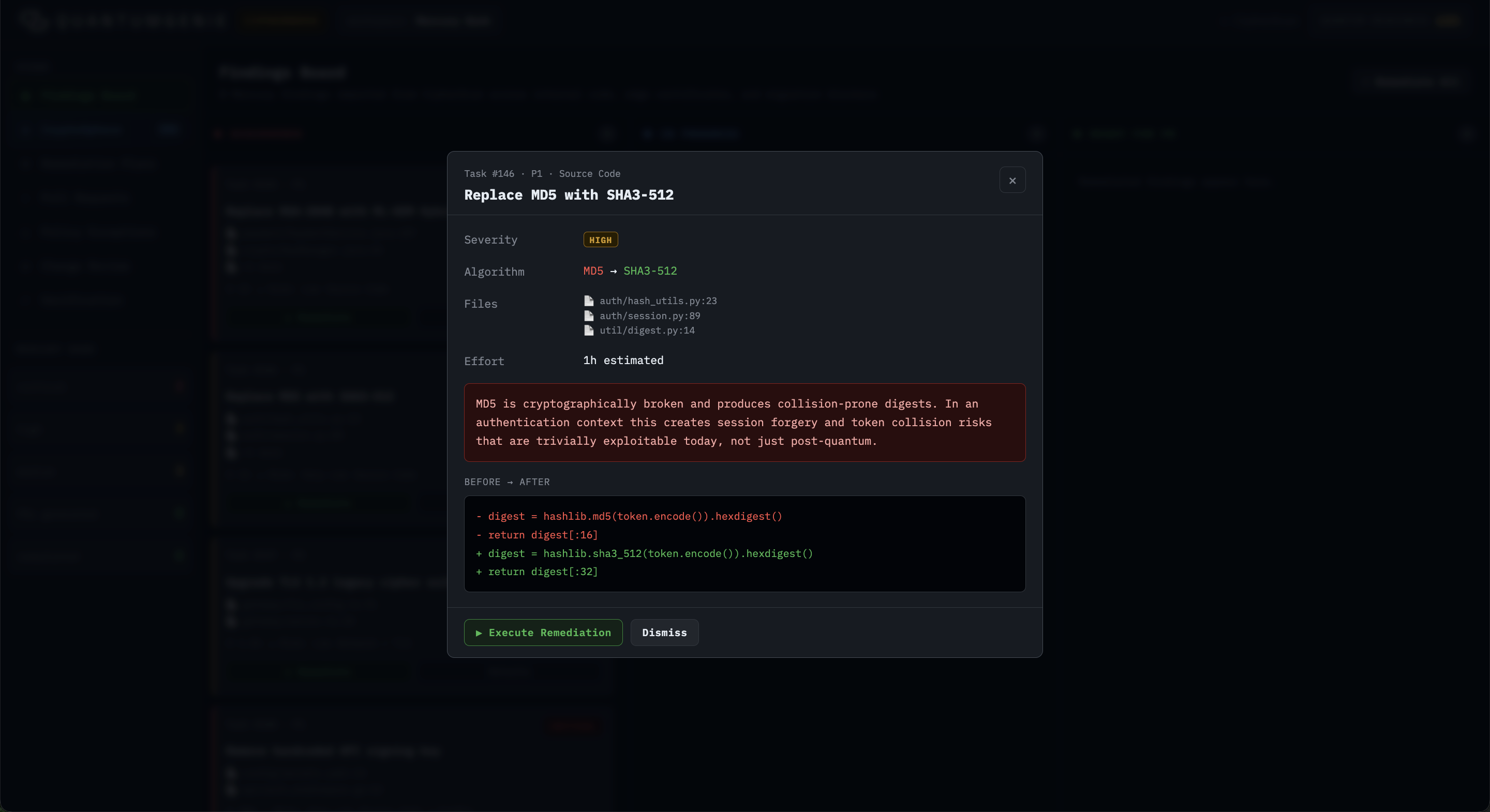
| Migration Planning | Develop detailed remediation plans aligned to regulatory deadlines | Actionable migration workflows with CipherNova |
| Compliance Evidence | Produce audit-ready documentation for regulatory verification | Reporting and audit trail capabilities |
How QuantumGenie Fits Into the EU Quantum Encryption Compliance Journey
QuantumGenie’s platform addresses this regulatory-driven complexity by delivering end-to-end cryptographic asset discovery through CipherScan, constructing a comprehensive cryptographic bill of materials (CBOM). This visibility enables enterprises to identify and prioritize quantum-vulnerable components across diverse systems.
Further, QuantumGenie’s CipherNova module operationalizes remediation workflows—managing pull requests, policy exceptions, and verifying changes—thereby facilitating efficient migration and demonstrating compliance readiness. By aligning technical actions with regulatory requirements, QuantumGenie ensures enterprises can meet the EU’s quantum encryption mandate with governance and confidence.
Frequently Asked Questions
Why is the EU mandating quantum-resistant encryption by 2030?
The EU anticipates that advances in quantum computing will soon render current cryptographic algorithms vulnerable, potentially exposing critical data. The regulation aims to proactively secure data by enforcing quantum-resistant encryption across all member states before such threats can be exploited.
How can enterprises begin preparing for these quantum encryption requirements?
Enterprises should start by thoroughly auditing their cryptographic assets, prioritizing migration paths based on risk, and implementing workflow-driven remediation plans. Leveraging tools that provide visibility and management of cryptography helps ensure readiness and compliant transition to quantum-resistant standards.
Watch The Quantum Threat
Sources And Further Reading
- EU Proposes New Regulations for Quantum-Resistant Encryption European Commission · Jul 5, 2024
- NIST Releases Final Post-Quantum Cryptography Standard National Institute of Standards and Technology · Jul 7, 2024
- US Government Releases Cybersecurity Framework for Quantum Computing Era Cybersecurity and Infrastructure Security Agency · Jul 2, 2024