In This Article
What This Means
- Regulatory Demands Drive Cryptographic Inventory as a Foundation
- Crypto Agility Requires Pre-Migration Architecture and Lifecycle Management
- How QuantumGenie Fits into This Enterprise Post-Quantum Framework
Regulatory Demands Drive Cryptographic Inventory as a Foundation
With the European Union rolling out stringent regulations such as DORA, NIS2, and the Cyber Resilience Act, enterprises are compelled to gain unprecedented visibility into their cryptographic assets and posture. CRYPTAGION’s recent launch of a post-quantum cryptographic inventory service directly addresses this urgent compliance need by helping organizations identify every cryptographic component, assess its quantum vulnerability, and generate a CycloneDX 1.6 CBOM. Without such a detailed cryptographic inventory, enterprises cannot realistically plan or prove readiness for quantum-resistant security.
This regulatory push reframes the post-quantum cryptography challenge for CISOs and enterprise architects—not merely as a cryptographic upgrade, but as a comprehensive asset management and risk prioritization problem. It demands tools that discover cryptography embedded in diverse environments—from code to certificates to infrastructure—forming a trusted foundation for migration planning.
Crypto Agility Requires Pre-Migration Architecture and Lifecycle Management
Building on asset visibility, post-quantum migration mandates cryptographic agility—the ability to swiftly switch algorithms without disrupting business operations. Insights from PQC Today highlight architecture patterns enabling this agility, emphasizing modularity and lifecycle orchestration to respond rapidly as quantum-safe algorithms mature and standards evolve.
Platforms like the one introduced by Eprion stress the importance of automating lifecycle management, but these solutions rely fundamentally on comprehensive knowledge of existing cryptographic assets. This operational visibility and lifecycle orchestration are only effective if underpinned by prior discovery and inventory efforts, confirming that migration success begins with awareness and structured management.
Key Enterprise Actions for Post-Quantum Cryptography Preparedness
| Enterprise Action | Description | Relevant Technologies/Standards |
|---|---|---|
| Cryptographic Asset Discovery | Systematic inventory of all cryptographic usage across systems and codebase | CycloneDX CBOM, Automated Cryptographic Scanners |
| Quantum Vulnerability Assessment | Evaluating cryptographic components against known quantum-breaking threats | Post-Quantum Cryptanalysis, Risk Scoring |
| Compliance Reporting | Generating evidence aligned with DORA, NIS2, Cyber Resilience Act | Regulatory Frameworks, Automated Reporting Tools |
| Cryptographic Agility Architecture | Designing systems for seamless algorithm replacement | Modular Crypto Libraries, API Abstraction |
How QuantumGenie Fits into This Enterprise Post-Quantum Framework
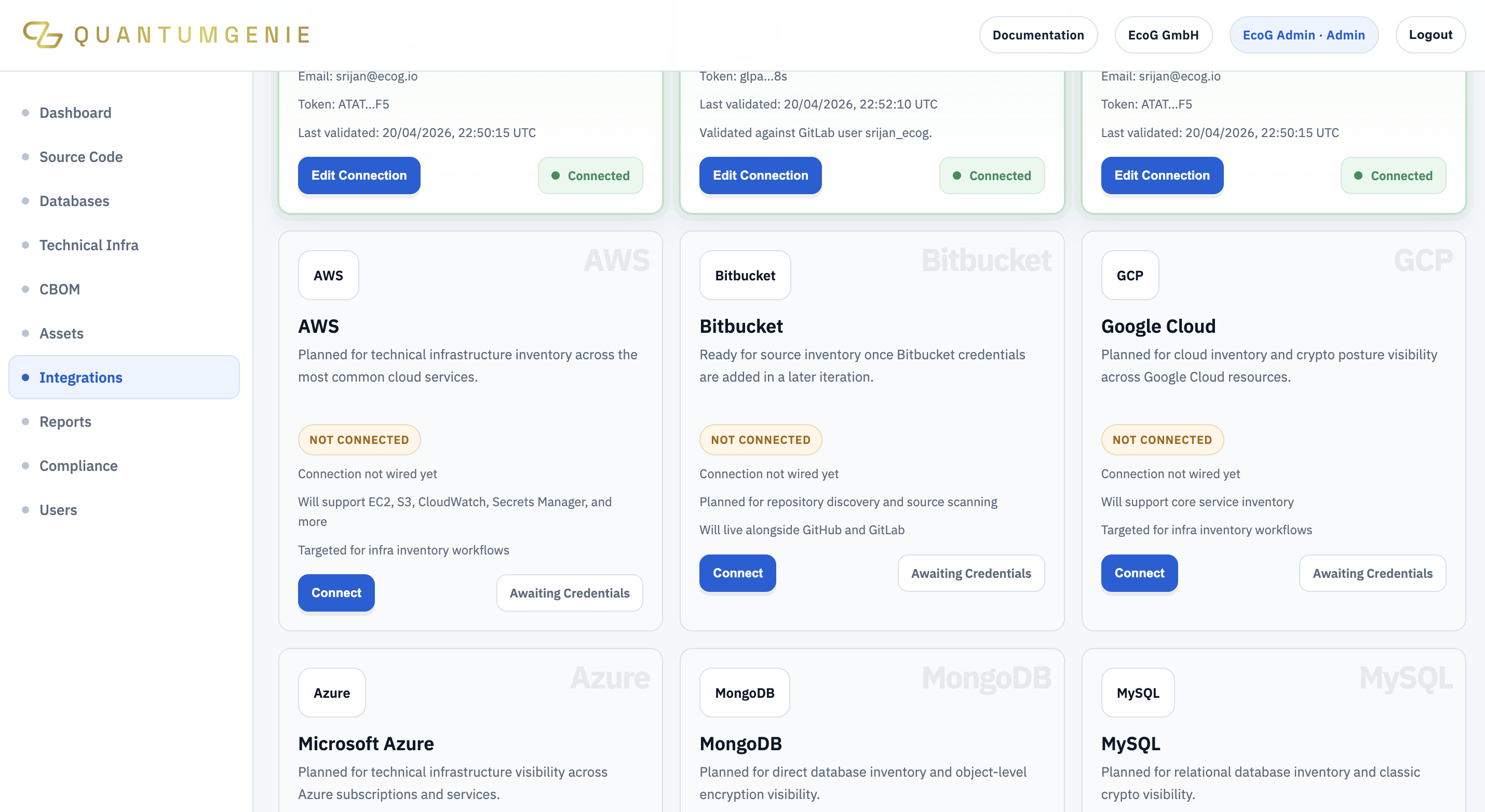
QuantumGenie complements this landscape by delivering deep cryptographic discovery and inventory capabilities across an enterprise’s full IT spectrum—websites, certificates, source code, databases, applications, and integrations. It enables teams to build a complete cryptographic bill of materials (CBOM), assess risks for quantum vulnerabilities, and prioritize remediation needs realistically.
Moreover, QuantumGenie operationalizes remediation workflows essential for migration programs—integrating pull requests, policy exception handling, change review, and verification steps—thus bridging the gap from inventory and risk assessment to efficient and governed post-quantum migration. For enterprises navigating complex compliance landscapes, such integrated platform support is indispensable to maintain security and regulatory readiness.
Frequently Asked Questions
Why is cryptographic inventory a critical first step before migrating to post-quantum algorithms?
Because many enterprises lack visibility into all places cryptography is used, without a complete inventory it's impossible to understand quantum risk exposure or plan an effective migration. Inventory ensures no cryptographic assets are overlooked, reducing migration failures and compliance gaps.
How do emerging EU regulations affect enterprise post-quantum cryptography strategies?
Regulations like DORA, NIS2, and the EU Cyber Resilience Act require organizations to prove cryptographic asset visibility, assess quantum risks, and demonstrate plans for migration. This drives enterprises to invest in discovery and compliance tools upfront rather than after a breach or audit failure.
Watch The Quantum Threat
Sources And Further Reading
- CRYPTAGION Offers Post-Quantum Cryptography Inventory for EU Enterprises CRYPTAGION · Jun 29, 2026
- PQC Today Discusses Crypto Agility and Architecture Patterns for PQC Migration PQC Today · Jun 29, 2026
- Eprion Introduces Unified Cryptographic Operations Platform for Post-Quantum Agility Eprion · Jun 28, 2026