In This Article
What This Means
- Post-Quantum Cryptography Enters the Cybercrime Arena
- Enterprise Implications and the Accelerator Effect
- How QuantumGenie Fits in the Rising PQC Threat Landscape
Post-Quantum Cryptography Enters the Cybercrime Arena
In a landmark development reported by Ars Technica, the Kyber ransomware family has become the first known malicious software to incorporate post-quantum cryptographic algorithms into its payload. This malware uses ML-KEM—a lattice-based encryption standard resistant to quantum attacks—posing a fresh and elevated threat that can potentially circumvent legacy defenses relying on classical cryptography.
This shift signals a watershed moment where adversaries are leveraging cutting-edge quantum-resistant encryption, dramatically raising the stakes for enterprise cybersecurity. It underscores that the adoption of post-quantum cryptography (PQC) is no longer just a theoretical future concern but an urgent imperative for defensive postures today.
Enterprise Implications and the Accelerator Effect
Supporting this urgency, industry leaders like Google have accelerated their quantum-safe encryption timelines, aiming for full infrastructure readiness by 2029—years ahead of most government mandates. Concurrently, security analyses emphasize that enterprises must migrate encryption schemes promptly to PQC standards finalized by NIST, or risk exposure as adversaries advance their capabilities.
Enterprises face a dual challenge: legacy systems remain vulnerable, while threat actors actively exploit PQC techniques offensively. Without a clear, strategic migration plan that includes comprehensive cryptographic inventories, prioritization of critical assets, and agile remediation workflows, organizations risk being blindsided by these evolving threats.
Summary of Key Enterprise Actions for PQC Preparedness
| Action | Objective | QuantumGenie Role |
|---|---|---|
| Cryptographic Inventory | Identify all cryptographic assets and vulnerable points | CipherScan provides automated discovery and visibility |
| Risk Prioritization | Focus on critical assets that expose highest risk | Inventory data enables targeted remediation planning |
| Migration Planning | Develop phased plans for replacing vulnerable crypto | Integrate CBOM to track progress and dependencies |
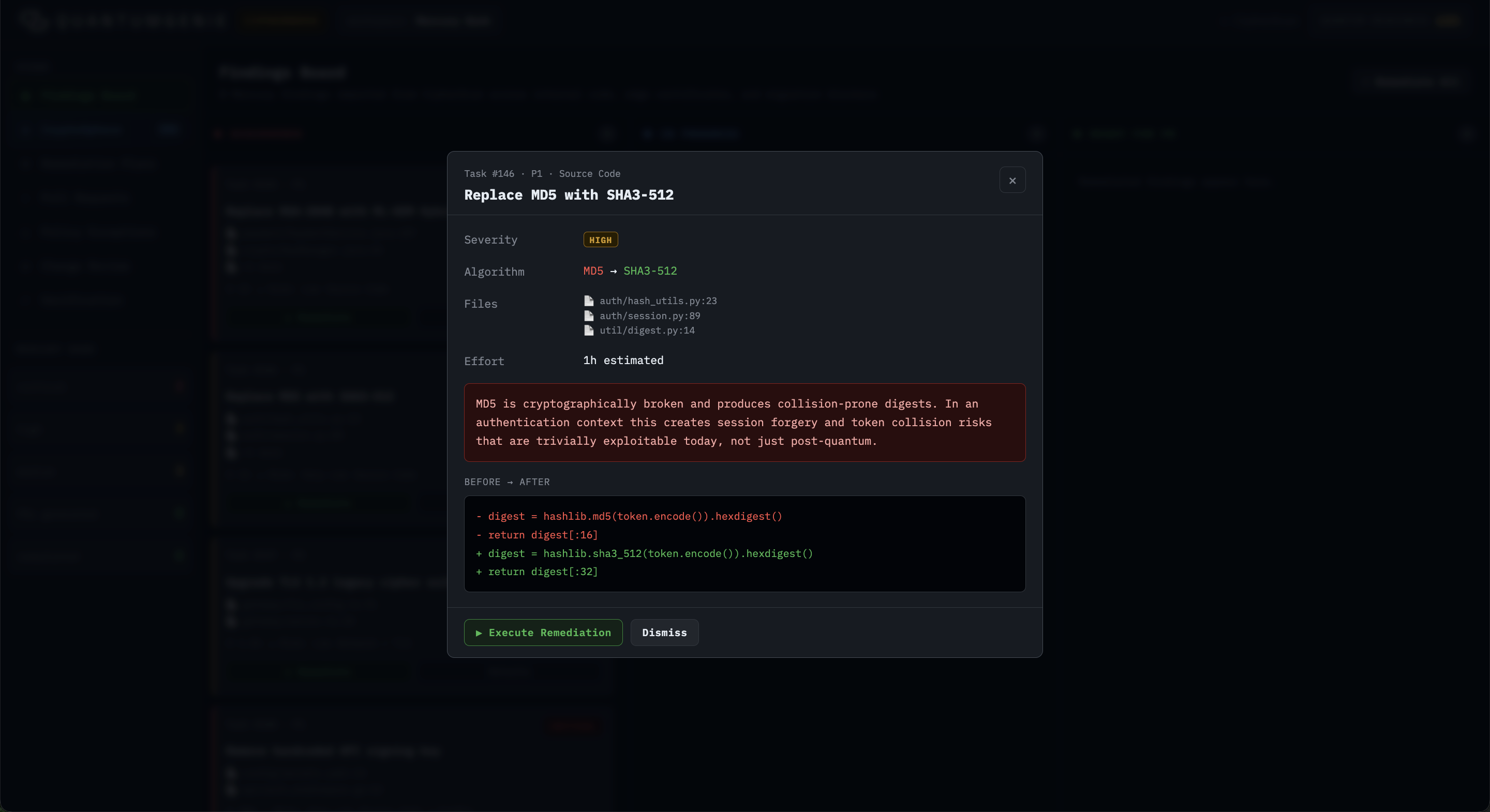
| Operational Remediation | Execute fixes through controlled, auditable workflows | CipherNova manages pull requests, policy exceptions, and verification |
How QuantumGenie Fits in the Rising PQC Threat Landscape
QuantumGenie addresses this challenge with its CipherScan product, providing enterprises comprehensive visibility into cryptographic assets—from source code and certificates to databases and integrations—exposing vulnerabilities before exploitation can occur. By creating an accurate cryptographic inventory and software bill of materials (CBOM), QuantumGenie helps security teams prioritize remediation efforts effectively against emergent quantum-era threats like PQC-enabled ransomware.
Moreover, QuantumGenie’s CipherNova layer orchestrates remediation workflows and change controls that enable enterprises to operationalize migration plans with minimal disruption. This capability aligns directly with the urgent need for enterprise security teams to move from awareness to action in migrating to quantum-safe encryption before adversaries entrench their quantum-capable presence.
Frequently Asked Questions
Why is the use of post-quantum cryptography by ransomware a game changer?
It means adversaries are adopting encryption methods that classical cryptanalysis cannot break, making traditional defenses ineffective against these advanced threats. Enterprises must respond by implementing quantum-safe cryptography to maintain security.
How can enterprises prioritize their migration to post-quantum cryptography effectively?
By first establishing a comprehensive cryptographic inventory to identify where vulnerable cryptographic assets exist and assessing risk exposure, enabling focused remediation on high-value systems and workflows.
Watch The Quantum Threat
Sources And Further Reading
- In a First, a Ransomware Family Is Confirmed to Be Quantum-Safe Ars Technica · Apr 23, 2026
- Google Sets 2029 Deadline for Quantum-Safe Encryption, Years Ahead of Government Targets TechSpot · Mar 27, 2026
- Post-Quantum Cryptography: Why Enterprises Must Transition Their Encryption Now Security Today · Apr 5, 2026